


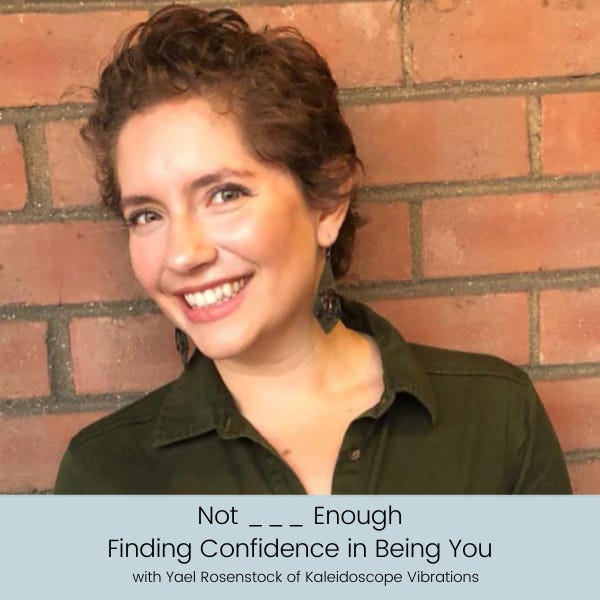
Not _______ Enough. Finding Confidence in Being You | Episode 34
Description
Yael R Rosenstock Gonzalez (she/her) is a sex educator, sex coach, researcher, author, speaker, curriculum developer, and workshop facilitator. As a queer, polyamorous, white-presenting Nuyorican Jew, Yael has always been interested in understanding the multi-level experiences of individuals. This led her to found Kaleidoscope Vibrations, LLC, a company dedicated to supporting and creating spaces for individuals to explore and find community in their identities. Through her company, she facilitates workshops, develops curriculum, offers Identity Exploration Coaching, and publishes narratives often left out of mainstream publishing.
This episode we explore:
* Honoring boundaries in community spaces and navigating POC spaces as a white presenting person
* Finding belonging and claiming identity as a multi-ethnic person
* Diversity in the Jewish diaspora
* Promoting inclusive representations of human experience in publishing
Episode Resources
https://www.sexpositiveyou.com/
https://www.instagram.com/yaelthesexgeek/
https://www.tiktok.com/@yaelthesexgeek
Hello and welcome to another episode of Body Liberation for All. I'm your host, Dalia Kinsey, holistic registered dietitian, and the author of Decolonizing Wellness.
My work is centered on amplifying the health and happiness of LGBTQI+ and BIPOC people. And that is also what we do here at Body Liberation for All.
I wanna remind you, I am hosting the Decolonizing Wellness Eco-Luxury QTBIPOC retreat in Bali in March. So if you are a person who loves the plan way in advance, like I do. This is when you want to book. This is a great time to give yourself plenty of room to break the trip into payments and to get all of your ducks in a row.
If you aren’t going to be able to join us, but you know someone who this retreat could be life changing for, please make sure you share it.
Substack makes sharing so easy on their platform. So if you visit daliakinsey.substack.com to listen to this episode you'll see it's just a click of a button.
Today's guest, the Yael Rosenstock has so much knowledge in different areas that we cover a lot of territory in this conversation. There was still so much more that we could have dug into that hopefully at a later date we'll get to revisit.
Today we explore a little bit of the lived experience of being a white presenting person who lives shoulder to shoulder with POC within the family, but out in the world is not having the same experience as the family members that have a darker complexion.
Since we already know race is not actually real from a scientific perspective, it's totally a social construct, your skin color itself will to a large extent determine how much lived experience you have as a person of color or as a white person, regardless of what the socialization inside of your house is like because so much of the POC experience, if you're living in a colonized country, if you're living in a country that has its roots in white supremacy, so much of the experience is informed by the anti-Blackness or the anti-POCness that you're going to encounter out in the world.
That does not in any way invalidate the cultural uniqueness of people who are in these very blended families and happen to have pale skin or white skin. So it's interesting to me to hear directly from somebody having this experience. It's an interesting concept to look at on an individual level. What does the fact that race is fictional and totally social have? How does that all play out - when you know you are culturally different from the white folks who do not have POC blood relatives that they live with and are close with but at the same time you know that you're not experiencing the same level of marginalization. What is that like?
I rarely bother to claim my Latinx heritage. Because the anti-blackness that I have encountered in a lot of Spanish-speaking circles here in the US is so intense it doesn't make any logical sense for me to keep trying to be somewhere that I don't feel welcome.
Some of these themes that Yael shares, the feeling of not enoughness when you are more than one thing or when you've only been presented with a narrow definition of what it means to hold a particular identity, is so relatable. I know not just to us, it's so relatable to so many people, because the ways that we define certain identities are so narrow it naturally leaves out a large number of people.
The work that Yael is doing to promote the authentic representation of a wide variety of human experience at her publishing company feels like such a natural extension of this lived experience that she has of knowing how difficult it can be to really claim and embody our identities when we haven't seen anything similar reflected back to us.
I love this. Entire conversation. I know you will too. Let's jump right into it.
Body Liberation for All Theme
Yeah. They might try to put you in a box, tell them that you don't accept when the world is tripping out tell them that you love yourself. Hey, Hey, smile on them live your life just like you like it is.
It’s your party negativity is not invited. For my queer folks, for my trans, people of color, let your voice be heard. Look in the mirror and say that it's time to put me first. You born to win. Head up high with confidence. This show is for everyone. So, I thank you for tuning in. Let's go.
Dalia: I definitely wanted to cover the concept of white passing fragility. But then I want to definitely talk about your other projects and just what you're doing with intersectionality.
Yael: Okay. I do want to warn that there's a very good chance that that will not. Some people will really like that idea of the white passing fragility, but others won't because right. The author of that book has become super famous and super rich off of a book around racism as a white woman. And just giving you a fair warning that this may or may not be taken so well.
Dalia: And then that's so interesting too, because it seems like people should be compensated for good work or things that they do with good intentions.
Dalia: But so often people who are in social justice are on the struggle bus financially, but, and that almost seems to be the expectation. Like you have to be a martyr to break down systems of oppression. But then I also am conflicted because it seems like all the time, white people continue to profit off of pain from people of color and especially Black people in this country. Even when you look at who makes money off of depictions of just Black suffering in general, whether it's another movie about slavery, even if it's a "fun" spin on it, like the Django or something, which I refuse to watch, I just don't understand how we're not seeing how problematic that is, but at least hers originally started out with intentions that seemed more educational.
Dalia: Like I think it's a little more sketch to create a film or a piece of entertainment that centered on Black pain. And then all the money goes to somebody who's not Black. I mean, not at all, but the majority, most of it, right. It seems less sketchy, but it is sketchy nonetheless.
Dalia: And I've been having a lot of feelings around these white savior complexes that are popping out these days. And people not understanding that, hey, maybe people want to be the hero of their own damn story and guess what, maybe they are ready are.
Yael: But you're in the way
Dalia: I know. Right? Or like you just exhausting people showing up to the March and explaining to everybody how, you know, you're being white the right way. I don't know if you've seen that play out in real life where people try constantly schooling other white people on how to be more. Down, I guess is the expression, but it doesn't really translate, but it's so rare that people confront people like that because their competition or the people that you have to compare them to you sometimes are so problematic that by comparison, they seem amazing.
Yael: Yeah, I like this better.
Dalia: So it's like, should I even say anything?
Dalia: So I don't know.
Yael: Considering that most of my spaces are POC and or Latin. I don't have that many white saviors.
Dalia: Smart. Okay. Is that by design or is that coincidental?
Yael: Well, I think at first it's coincidental, right? Just like growing up in a mixed neighborhood with a mixed family.
Yael: It just is what happened. I was in a school with folks of different groups. And so that just continued. And then when I did reach middle school and there were white people who were just white, not Latin, like, I mean, there were a couple in elementary, but not many. And. I just felt really uncomfortable in the space.
Yael: And that was like my assigned group. Cause I wasn't dark enough to be in the Latin group, I think. And also like the Latin group was like ghetto




 United States
